Nobody sits down to write their first blog post thinking it will disappear into the internet forever. The SEO writing skills that get you consistent traffic are not complicated, expensive, or reserved for people with years of experience. They are learnable, practical, and once you have them, they change the outcome of every single post you write from that point forward.
This post covers every skill you need, exactly why it matters, and how to start building it today, even if you are starting from absolute zero.
What are SEO writing skills and why do they define your career as a writer?
SEO writing skills are the combination of writing ability, strategic thinking, and technical awareness that allow a writer to create content people love to read and search engines reward with rankings. They are not two separate skill sets stuck together awkwardly. When developed properly, they work as one seamless craft.
For beginner writers in particular, these SEO content writing skills are not optional extras to add later. They are the foundation. A writer who publishes without them works twice as hard for half the results, wondering why their best posts never get found while less-talented writers consistently climb to page one.
What is the difference between a regular writer and an SEO writer?
A regular writer focuses on saying something well. An SEO writer focuses on saying something well to the right person at the exact moment they are searching for it. The writing quality can be identical. The strategic thinking behind the keyboard is completely different.
Can beginner writers really learn SEO writing skills from scratch?
Completely yes. Every professional SEO writer started with zero knowledge of search engines, keywords, or rankings. The skills covered below are learnable in weeks and refinable over months. The only requirement is consistency and the willingness to apply what you learn to every piece you write.
Skill 1– Keyword research: The foundation every SEO writer builds on
Every piece of content a skilled SEO writer produces starts not with an idea but with a keyword. Keyword research is the process of finding the exact phrases real people type into Google when they want answers and building your content around those phrases before writing a single sentence.
Without this skill, even beautifully written posts target topics nobody is actively searching for. A post titled “My Thoughts on Morning Productivity” competes with nothing and finds no one. A post titled “Morning Productivity Habits That Actually Work Before 7 am” is built around real search demand and has a genuine path to page one.
What does good keyword research actually look like for a beginner?
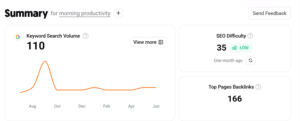
Start with free tools. Google Keyword Planner, Ubersuggest, and AnswerThePublic all provide beginners with enough data to identify real keyword opportunities without spending a single dollar. Look for keywords with consistent monthly search volume and low competition scores. The more specific the keyword, the lower the competition and the faster a newer blog can rank. Specificity is a beginner’s single greatest competitive weapon.
Skill 2– Understanding search intent before writing a single word
Search intent is the reason behind a search query. Someone typing “best camping tents” wants product recommendations, not a history of camping accessories. Someone typing “how to choose running shoes” wants guidance, not a product listing. The same broad topic, two completely different content formats required. Ubersuggest helps you understand the intent behind your search, as shown in the picture below.
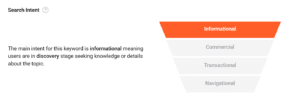
Matching search intent is arguably more important than keyword placement for beginner writers. A perfectly optimized post that misses the intent gets ignored by Google and abandoned by readers the moment they arrive and realize the content doesn’t match what their search implied.
How does missing search intent kill an otherwise great post?
Picture a writer in Lagos who spends three days crafting a detailed, research-heavy article about the science of sleep. They target the keyword “sleep better at night.” However, every person searching for that phrase wants practical, immediately applicable tips, not a neuroscience explanation. The reader lands, spends eight seconds, and leaves.
Google registers that bounce and drops the post further down the rankings. Meanwhile, a shorter, simpler post with seven practical sleep tips sits on page one, attracting daily clicks. The lesson is uncomfortable but important: readers do not reward effort. They reward relevance.
Skill 3– Writing with clarity, simplicity, and readability
Great SEO writing is never the most complicated writing in the room. It is the clearest. Readers make split-second decisions about whether to keep reading or leave, and clarity is the only thing that keeps them on the page long enough to engage with the content.
So, before you begin writing that post, make up your mind to be as clear and as simplified in your writing as possible.
Why is readability one of the most underrated SEO writing skills?
Because Google measures it indirectly through engagement signals. When readers stay on a page, scroll through it, and click internal links, Google interprets those actions as proof that the content served the search well. Short paragraphs, conversational language, and logically structured sentences all make content easier to consume, and easier content keeps readers on the page longer. Thus, readability is not just a writing preference. It is a ranking strategy.
Skill 4– Strategic keyword placement that feels completely natural
Knowing which keyword to target is only half the skill. Placing it where it carries the most SEO weight is the other half.
Where exactly should keywords appear in a blog post?
Your focus keyword belongs in the title, the second or third sentence of the introduction, at least two H2 subheadings, naturally within the body wherever the topic calls for it, the meta description, and the conclusion. That framework covers every high-value placement without requiring a single forced sentence. If a keyword appears awkward in a sentence, the sentence needs rewriting, not the keyword insertion.
Skill 5–- Structuring content with H2s and H3s that work for google
The structure level is where most beginner writers reveal that they are still thinking like readers rather than strategists. H2 and H3 subheadings are not formatting choices. They are structural signals that tell Google what a post covers at a glance and tell readers exactly where to find the specific answer they came looking for.
Every H2 should cover a major dimension of the topic. Every H3 should support its parent H2 with a specific, targeted point. Clear body copy must appear beneath every subheading before the next one begins. Two subheadings stacked without content between them are a structural signal that the post was assembled carelessly, and Google notices that as much as the reader does.
Skill 6– Writing headlines and title tags that stop the scroll
A title tag is the most important line in any piece of SEO content. It appears in search results, browser tabs, and social shares simultaneously. It is the first impression, the click decision, and the promise the reader holds the entire post accountable to.
What makes a title tag get clicked?
Here is the contrast using a cooking niche example:
Weak title tag: “Information About Making Pasta for Beginners Who Want to Cook at Home.”
Strong title tag: “7 Pasta Mistakes Every Beginner Makes at Home and How to Fix Them Tonight”
The weak version describes. The strong version provokes. It triggers the reader’s fear of making an embarrassing kitchen mistake, uses a number for scanability, and closes with “Tonight”, a word that transforms a casual interest into an urgent click. Every strong title does something similar: it speaks to the reader’s emotion before it speaks to their intellect.
Skill 7– On-Page SEO optimization every writer must understand
SEO content writing skills extend beyond the words inside your post. On-page SEO covers the technical elements that sit around your writing and tell search engines how to categorize, rank, and display it.
What On-Page SEO elements should every beginner Content writer know?
Every beginner needs to understand the five on-page elements without exception. The title tag must include the primary keyword near the beginning and remain within 60 characters. The meta description must be under 155 characters, contain the focus keyword naturally, and make a clear promise to earn the click.
The URL must be short, clean, and keyword-rich with hyphens between words. Image alt text must describe each image descriptively, using keyword variations where they fit naturally. Internal links must connect every new post to at least two existing posts on the same blog, passing authority and building topical depth simultaneously.
Skill 8– Research and fact-checking as a non-negotiable writing habit
Google’s E-E-A-T framework rewards content written from genuine experience and backed by credible sources. For beginner writers, this means developing the habit of verifying every claim before publishing it and citing sources that give readers confidence that the information is accurate and trustworthy.
A writer who publishes a statistic without checking it is one correction request away from losing a client, one viral counter-post away from damaging their credibility, and one Google algorithm update away from watching their rankings collapse. However, a writer who backs every significant claim with a named source builds the kind of content trust that compounds into long-term rankings and a reputation that attracts readers and clients without constant pitching.
Skill 9– Writing meta descriptions that drive real clicks
A meta description is the post’s only sales pitch in search results. I keep saying this. It does not directly affect rankings, but it controls whether a ranked post gets clicked or ignored. Hence, a weak meta description on a page-one result still loses traffic to a stronger meta description sitting in position three.
Every meta description needs a pain point or desire trigger in the opening sentence, the focus keyword placed naturally in the middle, and a subtle sense of urgency, close enough that clicking feels like the obvious and immediate next move. All of that in under 155 characters, written for a real human being who is scanning results in under three seconds and making a click decision.
Skill 10– The mindset skill nobody talks about but every SEO writer needs
If, as a beginner writer, you wait until the day you fully understand SEO before publishing, you will never publish. Writers who publish consistently, apply one new skill per post, review their Search Console data monthly, and refine as they go, build compounding results that eventually become a blog commanding lots of traffic.
How do you build SEO writing skills fast as a complete beginner?
Apply one skill to every post you write. Start with keyword research on your next post. Use the keyword placement framework on the one after that. Add strategic subheadings to the one after that. Within ten posts, you will have applied every skill on this list at least once, and application is the only teacher that actually works.
Knowing how to develop SEO writing skills from scratch is not about reading more articles. It is about writing more posts with deliberate intention behind every decision.
What separates writers who rank from writers who wonder
The writers building blogs that grow, landing clients who pay well, and watching their posts climb to page one are not more talented than the beginners reading this right now. They simply started applying these SEO writing skills earlier and applied them more consistently than everyone else in their niche.
Every skill on this list is available to any writer willing to practice it. None of them require a marketing degree or years of industry experience. They require the discipline to think strategically before writing, to write clearly when you sit down, and to optimize deliberately before you publish.
However, if you wish to have your hands held while you navigate these skills, visit Venus Writingstyles Academy for a total breakdown and guidance.
The gap between a writer who ranks and a writer who wonders is not a matter of talent. It is not niche. It is not even time. It is the decision to treat every post as a strategic asset rather than a creative exercise, and that decision is entirely yours to make, starting with your very next post.
Every skill you build today is a post that ranks tomorrow, a reader who stays, a client who hires you, and a blog that grows long after you have closed the laptop and gone to sleep. Save this post and use it as a guide for the next post you publish.