Your blog is failing because every single post you have published has walked into Google completely naked. No optimization, no structure, no signal telling search engines what it is, who it is for, or why it deserves to rank above the thousands of other posts competing for the exact same reader. This SEO checklist for blog posts you are about to get will make the difference between a post that gets dressed for success before it leaves the house and one that shows up to the interview in pajamas and wonders why it did not get the job.
Every blogger who consistently ranks on page one is not necessarily a better writer than you. They are a more systematic one. They follow a process before, during, and after every post, and this checklist outlines that process.
Why most blog posts never rank and what a checklist changes
Your blog posts never rank because you wrote them on instinct rather than strategy. You chose a topic you felt passionate about, picked a title that sounded good to you, wrote the best post you could, and hit publish without a single optimization check. That approach produces content that feels good to write but goes nowhere in search results.
However, adopting a repeatable system changes that outcome completely for you. When every post goes through the same pre-writing, writing, and pre-publishing checks before it goes live, it will give every post a genuine shot at ranking by removing the guesswork from the decision.
What is an SEO checklist for blog posts and why do you need one?
A blog post SEO checklist is a step-by-step optimization framework that ensures every post you publish is built to be found, read, and ranked. To put your mind at ease, it is not a rigid formula that strips your voice from your writing; rather, it is a system that gives your writing the structural and technical foundation it needs to compete in search results.
For bloggers just starting out, especially those building blogs from Nigeria, the USA, and markets where competition is fierce and every click counts, a blog post SEO checklist for beginners is the single fastest way for you to close the gap between publishing blind and publishing with confidence.
More so, it turns optimization from an afterthought into a habit, and habits are what build blogs that grow consistently month after month.
How does a blog post SEO checklist help you rank faster?
Picture two bloggers writing posts on the exact same topic, the same week. The first blogger writes a solid post, titles it well enough, and hits publish. The second blogger validates the keyword first, structures the post around search intent, places the focus keyword in the right positions, writes a compelling meta description, adds internal links, and submits the URL to Google Search Console immediately after publishing.
Two weeks later, the first blogger’s post is sitting on page four with twelve impressions. The second blogger’s post is climbing through page two with four hundred impressions and a click-through rate, and Google is already rewarding with higher test positions. Same topic. Same niche. Completely different outcomes because one blogger had a system and the other had instinct.
PHASE 1 — The SEO checklist for blog posts before you write a word
The pre-writing phase is the most important and most skipped part of the entire blogging process. Therefore, the decisions you make before writing your first sentence determine whether that post ranks or disappears, and no amount of excellent writing afterward can compensate for a weak strategic foundation.
Hence, knowing how to optimize a blog post for SEO step by step starts here, even before you open your writing tool, before the title is written, and before you type that word in your head.
Have you chosen a keyword with real search demand?
Now, choosing a keyword without validating its search demand is like opening a restaurant on a road nobody drives down. The food might be outstanding, but the location guarantees an empty dining room. In the picture below, the ‘Search Volume’ signifies that real people are searching for the keyword ‘Red running shoes’ monthly.
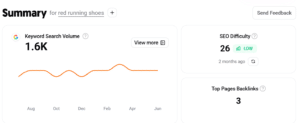
Before writing that post, run your topic through a free keyword tool like Google Keyword Planner, Ubersuggest, or AnswerThePublic. Confirm that real people are actively searching for it every month. Check the keyword difficulty score (in the image above); a lower score indicates less competition, so a newer blog has a genuine chance of ranking without years of domain authority behind it.
For example, a blogger in Nigeria writing about personal finance might feel tempted to target the keyword “how to save money.” That keyword has enormous search volume and enormous competition, dominated entirely by major financial publications. Pay attention to the high SEO Search difficulty.
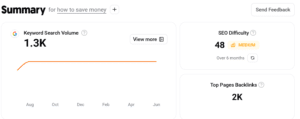
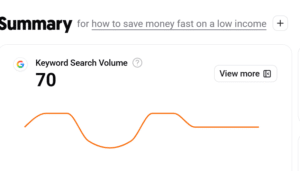
However, the keyword “how to save money on a low income in Nigeria” has specific demand, lower competition, and a highly targeted audience that feels personally spoken to the moment they see it in search results. Specificity is the beginner blogger’s most powerful competitive advantage.
Do you know exactly what your reader wants from this post?
Search intent is the reason behind a search query, and misreading it is one of the most common reasons well-written posts fail to rank, regardless of how technically optimized they are.
Here is a real example of what intent mismatch looks like in practice. If you, as a blogger, target the keyword “best running shoes.” Then you write a detailed, well-researched post about the history of running shoe technology, the biomechanics of running, and the materials that make a great running shoe. It is genuinely excellent content.
However, every person searching for “best running shoes” wants a list of specific shoes they can buy right now, not a history lesson. The intent is commercial and can also serve a transactional purpose. But the content you wrote was informational. Google recognizes that mismatch immediately, and the post ranks nowhere near page one.
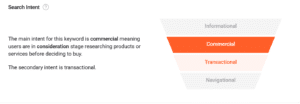
Before writing, search for your target keyword and read the top five results. They tell you precisely what format, depth, tone, and angle Google has already determined best satisfies the searcher’s intent for that keyword.
Have you checked what the top-ranking posts are already doing?
Studying the competition before writing is not copying; it is intelligence gathering. The posts currently ranking on page one for your target keyword are there because Google has evaluated them against every other post on the topic and determined they best satisfy the searcher’s need. They are showing you the standard your post needs to meet and exceed.
Look at their subheadings. What questions are they answering? What questions are they missing? Look at their word count. Are they comprehensive or surprisingly thin? Check their PAA boxes. Every question in Google’s People Also Ask section for your keyword is a content gap your post can fill that the ranking posts may have ignored.
Hence, the goal is not to write a post similar to what is already ranking. The goal is to write a post that covers everything the ranking posts cover and then fills every gap they left open.
PHASE 2 — The SEO checklist for blog posts while you write
The writing phase is when strategy and creativity must work together without either suffocating the other. The SEO blog writing tips in this phase will keep you on the right side of both extremes simultaneously.
Is your focus keyword in the right places?
Keyword placement matters far more than keyword frequency. A focus keyword that appears in the right six positions carries more SEO weight than the same keyword forced into twenty sentences throughout the post.
Here is the exact placement framework that works consistently:
- H1 title– Primary keyword as close to the front as the headline naturally allows
- Second or third sentence of the intro– Where Google’s crawler looks first for topical relevance
- At least 2 H2 subheadings– Structural reinforcement that confirms the post’s topic focus
- Naturally in the body– Wherever the topic calls for it without forcing
- Meta description– Where it bolds in search results and pulls the reader’s eye to your listing
- Image alt text– A small but consistent signal that adds up across every post on your blog
- Conclusion– A natural final mention that closes the content loop for both readers and search engines
Does your title tag make someone want to click immediately?
Let me hold your hand while I say this: your title tag is not just a headline; it is a click decision made in under two seconds as a reader scans a page of search results. Here is the difference between a title that gets skipped and one that gets clicked, using a home improvement niche example:
Weak title tag: “Home Renovation Tips and Information for Homeowners Who Want to Improve Their Space.”
Strong title tag: “11 Home Renovation Mistakes That Cost Homeowners Thousands, And How to Avoid Every One”
The weak title describes. The strong title provokes. It triggers the reader’s fear of making an expensive mistake, uses a specific number for scanability, and makes clicking feel like a financially protective decision. That emotional trigger is what separates a 2% click-through rate from an 8% one on the exact same ranking position.
Is your intro built to hook and hold the reader?
Google tracks what readers do after they click your result. When someone lands on your post and leaves within fifteen seconds, Google interprets that bounce as evidence that your content did not deliver what the search promised, and your ranking drops accordingly. Thus, a strong intro is not just a writing choice. It is a ranking decision.
Your intro needs to do three things in the first three sentences: address the reader’s pain point so specifically that they feel seen, place your focus keyword naturally within the second or third sentence, and make a promise clear enough that the reader has a compelling reason to keep scrolling past the opening paragraph.
An intro that starts with “In this post, we will discuss…” fails all three of those requirements simultaneously. An intro that opens with the reader’s exact frustration, names what is causing it, and promises a specific resolution passes all three, and keeps the reader on the page long enough for Google to notice.
Are your H2 and H3 subheadings working as hard as they should?
Please note that subheadings are simultaneously a reader navigation tool and a Google ranking signal, and treating them as one without the other wastes half their value. A subheading that clearly mirrors a real search query tells Google your post covers that specific angle of the topic. A vague subheading tells Google nothing useful.
Compare these two subheadings on the same point:
Vague subheading: “About Keywords.”
Strategic subheading: “Where Should You Place Keywords in a Blog Post for Maximum SEO Impact?”
The second version mirrors a real PAA question, naturally includes a secondary keyword, tells Google exactly what that section covers, and gives a reader scanning the post a clear reason to stop and read that specific section. Every H2 and H3 in your post should pass that same test, and every subheading must have clear body copy written beneath it before the next heading appears.
Have you written a meta description that drives clicks?
A meta description is your post’s only sales pitch in search results. Leaving it blank or writing it as a lazy summary is handing potential clicks directly to your competitors. Meanwhile, a well-written meta description directly influences your click-through rate, and a consistently high CTR signals to Google that your result is exactly what searchers want, which improves your ranking over time.
Every strong meta description on your on page SEO checklist needs three elements working together: a pain point or desire trigger that speaks to the reader’s specific situation in the opening, a natural appearance of the focus keyword in the middle, and a subtle urgency close that makes clicking feel like the obvious next move. All of that in under 155 characters, written for a human being, never for an algorithm.
PHASE 3 — The SEO checklist for blog posts before you hit publish
The pre-publish checks below are the final quality gate that every post must pass before it goes live. The SEO checklist for blog posts before publishing and the question of what to check before publishing a blog post share the same answer. These items below are applied consistently, every single time.
Have you added internal links to and from this post?
Internal links are among the most powerful items on any blog SEO optimization checklist, yet consistently the most ignored. Every internal link you add serves three purposes simultaneously: it passes page authority from stronger posts to newer ones, it keeps readers on your blog longer by giving them a natural next step, and it builds topical authority by showing Google that your blog covers a subject comprehensively from multiple angles.
Before publishing any new post, link to at least two existing posts on your blog that are topically related. Then, immediately after publishing, go back to those older posts and add a link pointing to your new one. That two-way internal linking creates a network of authority that grows stronger with every post you add.
Is your URL short, clean, and keyword-rich?
Your URL is a small but genuine ranking signal. It is far easier to get right before publishing than to fix after a post has been indexed. A clean URL contains your focus keyword, uses hyphens between words, and strips out every unnecessary word that adds length without adding relevance.
Here is the direct contrast:
Weak URL: yourblog.com/2025/06/here-are-some-tips-about-seo-for-blog-posts-that-you-should-know
Strong URL: yourblog.com/seo-checklist-for-blog-posts
The strong URL tells Google and the reader exactly what the page covers in five words. It is clean, memorable, keyword-rich, and carries none of the date stamps or filler phrases that dilute its relevance signal.
Have you optimized every image in the post?
Three things need to happen with every image before a post goes live. First, compress the file size. Large uncompressed images slow page load times, and page speed is a direct ranking factor that Google takes seriously.
Second, rename the file descriptively before uploading. seo-checklist-blog-posts.jpg tells Google something useful; IMG_4729.jpg tells Google nothing. Third, write descriptive alt text for every image using a natural variation of your focus keyword where it fits. Alt text is what Google reads when it cannot visually process an image. It is a quiet but consistent SEO signal that adds up across every post on your blog over time.
Is your post readable on a mobile screen?
More than 60% of all Google searches occur on mobile devices. which means Google’s primary evaluation of your content happens on a mobile screen, not a desktop one. A post that reads beautifully on a laptop but breaks into unreadable walls of text on a phone is a post Google will consistently rank lower than a mobile-optimized competitor.
Before publishing, open your post on your phone. Check that paragraphs are short enough to read comfortably without scrolling past endless blocks of text. Confirm that font sizes are large enough to read without zooming. Make sure images are not spilling outside the screen edges. These are small checks that take under three minutes and protect your rankings from a technical penalty most bloggers never realize they are facing.
What to do after publishing — The post-publish SEO checklist
Most SEO checklists end at the publish button. It means most bloggers are leaving significant ranking speed on the table every single time they go live with a new post. The post-publish phase is where the fastest gains happen for bloggers who know how to rank a blog post on Google fast. And so it starts within the first hour of publishing.
Have you submitted your post to Google Search Console?
Waiting for Google to organically discover a new post is the slowest possible path to indexing. Google can take anywhere from a few days to several weeks to crawl and index a new post on its own, and during that time, your post is earning zero impressions, zero clicks, and zero ranking signals.
Google Search Console eliminates that wait. Open Search Console, paste your new post’s URL into the URL inspection tool, and click “Request Indexing.” Google prioritizes manually submitted URLs for faster crawling. Moreover, faster crawling means faster indexing, so your post starts accumulating ranking signals days earlier than it would otherwise. This single two-minute step consistently accelerates the early ranking timeline for new posts more than almost any other post-publish action.
How soon should you check your post’s performance after publishing?
For the first 72 hours, check that the post has been indexed using the URL inspection tool in Search Console. If it shows as indexed, Google has found it. If not, request indexing again.
In the first two weeks, look for impression data in Search Console’s Performance report. Impressions mean Google is showing your post to searchers, even if nobody is clicking yet. Impressions without clicks signal a title or meta description problem. Impressions with clicks signal the post is working and needs time to climb.
In the first three months, track your average position for the target keyword. A post moving from position 35 to position 18 is gaining momentum and may need a small optimization push, a stronger intro, an additional internal link, or an expanded section to break into page one.
How to use this SEO checklist for blog posts every single time you publish
Before I round off, you need to understand that the difference between a blog that grows and one that stalls is not talent, niche, or luck. It is the discipline to run every post through a system that gives it the best possible chance of being found by the exact reader it was written for, every single time you hit publish.
You must also understand that reading a checklist once is information. However, using it every single time you publish is the habit that builds a blog nobody can ignore.
Over twelve months, that consistency compounds into a blog where every post has a genuine shot at page one, where older posts keep climbing because they were built correctly from the start, and where new posts rank faster because the blog’s growing authority lifts everything it publishes.
The blog post SEO checklist is not a one-time read. It is a publishing standard. Download it. Save it. Open it every single time you start a new post, and watch what consistent optimization does to a blog that has been publishing on instinct for too long.